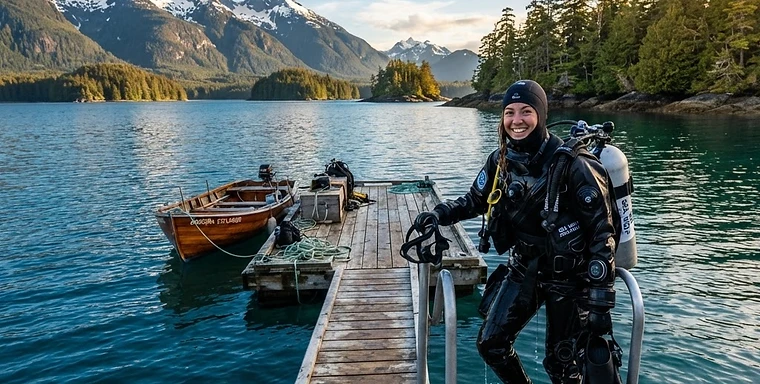
September is a magical time for scuba diving in Canada. As the summer heat fades and the crisp autumn air settles in, the algae blooms of warmer months begin to die off, leaving behind some of the clearest underwater visibility of the year. Whether you are exploring the emerald kelp forests off the coast of British Columbia or navigating the haunting, perfectly preserved shipwrecks of Tobermory, Ontario, fall offers a spectacular window for underwater adventure.
At the same time, September marks the beginning of travel planning season. Canadian snowbirds are already dusting off their dive gear in preparation for winter escapes to Florida or the Caribbean, while international students and working holiday visa holders are settling into Canada, eager to explore their new backyard.
But whether you are diving in the chilly, nutrient-rich waters of the Pacific Northwest or planning a tropical winter getaway, there is one critical aspect of dive safety that rarely makes it into the glossy travel brochures: the staggering cost of hyperbaric chamber treatments.
The Unspoken Reality of Decompression Sickness
Scuba diving is a remarkably safe and enjoyable activity when proper protocols are followed. Divers are trained to monitor their depth, watch their bottom time, and ascend slowly to allow their bodies to off-gas absorbed nitrogen.
However, the underwater environment is unpredictable. A sudden current, an equipment malfunction, or an unexpected need to assist a dive buddy can lead to a rapid ascent. When this happens, nitrogen bubbles can form in the bloodstream and tissues, leading to decompression sickness (DCS), commonly known as "the bends."
DCS is a serious medical emergency. Symptoms can range from joint pain and skin rashes to severe neurological issues, paralysis, and life-threatening complications. The definitive treatment for DCS is Hyperbaric Oxygen Therapy (HBOT), which involves placing the patient in a specialized pressurized chamber and administering 100% pure oxygen. This process shrinks the nitrogen bubbles and allows the body to safely absorb and expel them.
The Cost Nobody Mentions
While divers are well aware of the physical risks of DCS, very few are prepared for the financial shock of treatment.
Hyperbaric chambers are highly specialized pieces of medical equipment. They require dedicated facilities, highly trained medical staff, and significant operational resources. Because of this, the cost of treatment is exceptionally high.
Depending on the location and the severity of the condition, emergency hyperbaric chamber treatments for decompression sickness can easily cost between $3,000 and $10,000 per session. Because DCS often requires multiple sessions to fully resolve, the chamber costs alone can quickly become astronomical.
But the chamber is only part of the equation. Hyperbaric facilities are relatively rare. If you are diving in a remote location—such as a liveaboard in the tropics or a secluded cove on Vancouver Island—you will likely need an emergency medical evacuation to reach the nearest chamber. Air ambulances and helicopter rescues from remote dive sites or open water can easily push the total cost of a diving emergency well past the $25,000 mark.
Why Your Standard Coverage Might Leave You High and Dry
One of the most common—and dangerous—mistakes divers make is assuming that their standard travel insurance or provincial healthcare plan will cover a diving emergency.
If you are a Canadian travelling out of province, your provincial health plan provides very limited coverage. It typically will not cover the cost of private air ambulances, and out-of-province hyperbaric treatments may not be fully reimbursed, leaving you on the hook for thousands of dollars.
For those relying on standard travel insurance, the fine print often contains surprising exclusions. Many basic policies exclude scuba diving entirely, classifying it as a hazardous extreme sport. Others may cover diving, but only up to a very shallow depth limit (often 30 feet or less), which is impractical for most certified divers. Furthermore, standard policies may exclude specialized treatments like HBOT or fail to provide adequate limits for remote medical evacuations.
Tailoring Your Protection for the Water
Whether you are a local resident, a visitor, or a snowbird, having the right coverage is just as important as checking your air supply before a dive.
If you are an international student, a working holiday maker, or simply visiting to explore our beautiful coastlines, securing robust visitors to Canada insurance is your first line of defense. You must ensure that your policy can be upgraded or tailored to include adventure sports.
For Canadians preparing to head south for the winter, your standard snowbird coverage is excellent for everyday medical emergencies, but if you plan to spend your winter exploring coral reefs, you need to verify that your policy extends to your underwater activities.
To truly dive with peace of mind, you need a policy that explicitly covers scuba diving. A specialized adventure sports add-on is designed to bridge the gap left by standard policies, ensuring that you are protected for the specific risks associated with the sport.
Your Pre-Dive Insurance Checklist
Before you pack your regulator and fins this season, take ten minutes to review your travel insurance policy. Here is exactly what you should be looking for:
- Depth Limits: Ensure the policy covers you for the maximum depth you are certified for and plan to dive. If you hold an Advanced Open Water certification and plan to dive to 100 feet, a policy capped at 30 feet will not protect you.
- Hyperbaric Chamber Treatment: Look for explicit language stating that recompression and hyperbaric oxygen therapy are covered in the event of a diving accident.
- Medical Evacuation: Verify that the policy includes high limits for emergency medical evacuation. If you are diving in remote areas, you want to ensure a helicopter or air ambulance is fully covered.
- Activity Exclusions: Check if the policy excludes specific types of diving, such as wreck diving, night diving, or diving without a professional guide.
- Equipment Coverage: While your health is the priority, dive gear is expensive. Some specialized policies offer coverage for lost, stolen, or damaged equipment, which is a fantastic bonus.
Dive Safely This Season
Canada's fall diving season offers some of the most breathtaking underwater experiences in the world, and the tropical waters awaiting our snowbirds are equally inviting. Scuba diving is a sport that allows us to explore a world few get to see, but it demands respect, preparation, and responsibility.
By understanding the hidden costs of hyperbaric treatments and ensuring you have the right travel insurance in place, you can focus on what really matters: the incredible marine life, the weightless glide through the water, and the unforgettable memories you will make beneath the surface. Dive safe, check your gear, and always make sure your coverage is as deep as your sense of adventure.